- 1. The Dense Paradigm Limit & Meta's MoE Pivot
- 2. Training Infrastructure: 100,000 H100s & RoCE Networking
- 3. Native Early-Fusion Multimodal Tokenization
- 4. Multi-Token Prediction (MTP) & Speculative Decoding
- 5. Projected Model Tiers & Workstation Sizing
- 6. Geopolitical & Open-Source Ecosystem Ramifications
- 7. Frequently Asked Questions
1. The Dense Paradigm Limit & Meta's MoE Pivot
Meta's Llama 3 project represented the absolute pinnacle of dense autoregressive scaling. The 405-billion parameter checkpoint demonstrated that a dense model trained on 15.6 trillion tokens could match proprietary frontier systems like GPT-4 across diverse academic benchmarks.
However, real-world deployment revealed fundamental operational hurdles. Serving Llama 3 405B requires an 8x H100 node running at full 16-bit precision, or at minimum 4x A100/H100 GPUs using FP8 quantization. For the vast majority of enterprise developers and independent researchers, hosting costs proved prohibitive. Furthermore, decoding throughput remained constrained by memory bandwidth: reading 405 billion parameters sequentially to generate a single token imposes a hard theoretical ceiling on tokens per second.
With Llama 4, Meta's Fundamental AI Research (FAIR) team and GenAI engineering division have made an irrevocable pivot toward Sparse Mixture-of-Experts (MoE). By decoupling total parameter capacity from per-token compute, Llama 4 aims to provide the knowledge depth of an 800-billion parameter system with the inference speed and memory overhead of a 60-billion parameter model.
2. Training Infrastructure: 100,000 H100s & RoCE Networking
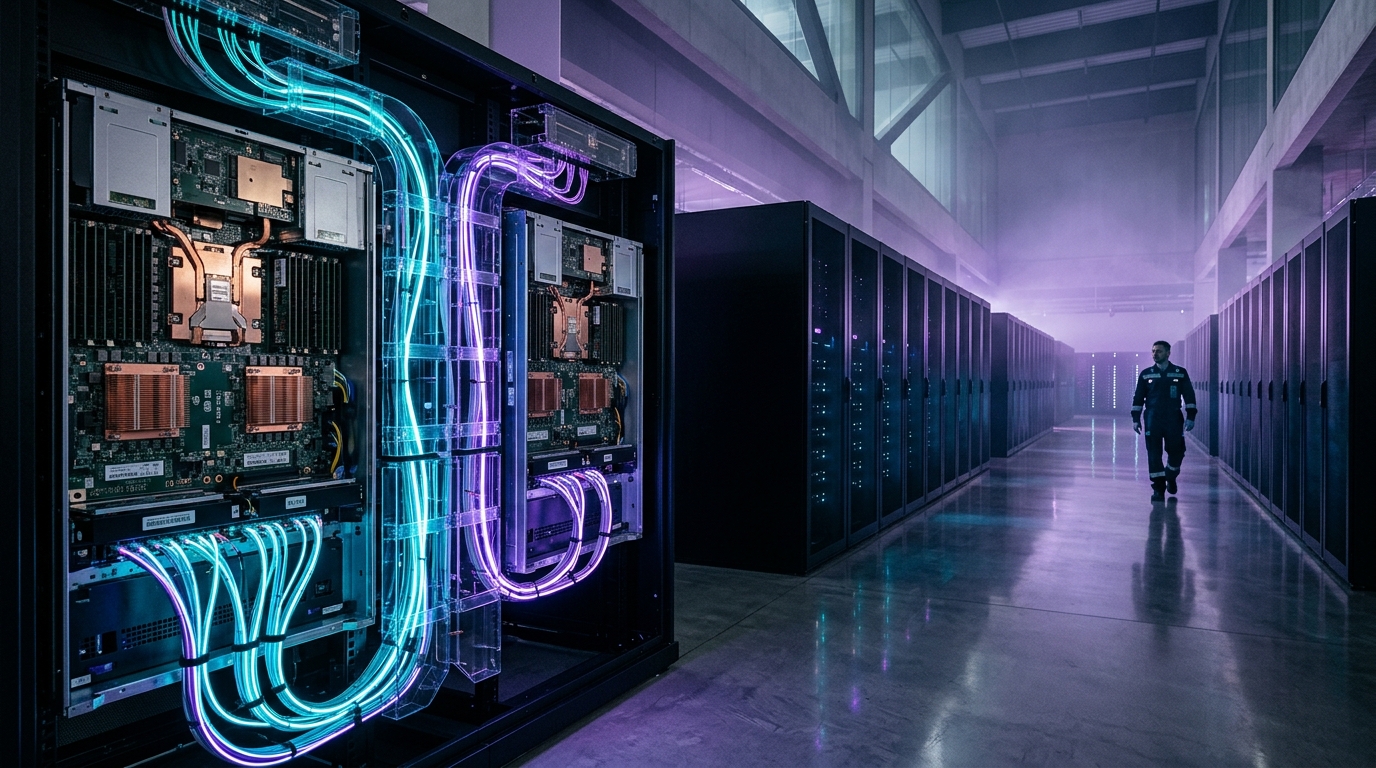
Training a multi-trillion parameter MoE model requires unprecedented scale. Mark Zuckerberg confirmed that Meta's infrastructure footprint surpassed 600,000 H100-equivalent compute units by the end of 2024, with two dedicated 24,000-GPU clusters expanding into unified 100,000-accelerator training fabrics.
Crucially, Meta pioneered the use of RDMA over Converged Ethernet (RoCEv2) on Arista switching hardware rather than relying exclusively on proprietary NVIDIA InfiniBand. This architecture leverages Meta's open Minipack3 network switches and custom PyTorch 2.x FSDP (Fully Sharded Data Parallel) communication primitives to sustain 400 Gbps per host with zero packet drop.
For a historical perspective on how cloud computing evolved from basic object storage to these planetary-scale clusters, read our flagship historical analysis on From S3 to Distributed GPU Clusters.
3. Native Early-Fusion Multimodal Tokenization
In previous releases (Llama 3.2 11B and 90B Vision), Meta introduced cross-attention vision adapters trained on top of a frozen text foundation. While effective, this late-fusion approach incurred substantial synchronization overhead and struggled with interleaved video comprehension.
Llama 4 adopts native early-fusion multimodal representation:
- Unified Token Vocabulary: Text, code, high-resolution image patches, and discrete audio tokens (leveraging Meta's EnCodec and Mimi neural audio codecs) share a common dictionary space exceeding 256,000 tokens.
- Direct Temporal Video Processing: Llama 4 natively tokenizes 30-fps video frames with spatio-temporal rotary embeddings, enabling direct visual reasoning over multi-minute video streams without external frame-splitting pipelines.
4. Multi-Token Prediction (MTP) & Speculative Decoding
Meta researchers recently published foundational work demonstrating that modifying the training objective from single next-token prediction to Multi-Token Prediction (MTP) significantly improves sample efficiency and downstream code synthesis.
In Llama 4, auxiliary prediction heads forecast tokens t+1, t+2, dots, t+4 simultaneously during training. At inference time, these prediction heads serve as built-in speculative draft models, allowing the model to generate up to 2.5x to 3x more tokens per second during code generation without requiring a separate draft model.
5. Projected Model Tiers & Workstation Sizing
Meta is projected to release Llama 4 in multiple operational tiers designed to target distinct enterprise and edge hardware profiles:
| Anticipated Tier | Total / Active Parameters | Target Context | Recommended Deployment Hardware |
|---|---|---|---|
| Llama 4 Small (MoE) | ~48B Total / 8B Active | 128,000 tokens | Single RTX 4090 24GB (Q4_K_M) or Apple Mac 36GB |
| Llama 4 Medium (MoE) | ~160B Total / 24B Active | 256,000 tokens | Dual RTX 3090/4090 (48GB) or Mac 64GB+ |
| Llama 4 Flagship (MoE) | ~650B Total / 64B Active | 512,000 tokens | 4x to 8x H100 80GB or Mac Studio 192GB Unified Memory |
To calculate your local VRAM requirements and hardware compatibility before release, visit our LLM GPU VRAM Calculator.
6. Geopolitical & Open-Source Ecosystem Ramifications
Meta's open-weights strategy has fundamentally democratized artificial intelligence. By continuing to release foundation weights under the Meta Llama Community License, organizations worldwide avoid proprietary lock-in. Enterprises can fine-tune specialized domain models, air-gap critical operations, and maintain full data sovereignty.
7. Frequently Asked Questions
When will Llama 4 be publicly released?
Meta executives have signaled that Llama 4 training runs will conclude in mid-2026, with staged releases of smaller MoE variants followed by the flagship tier toward late 2026.
Will Llama 4 require NVIDIA GPUs or run on AMD and Apple Silicon?
While training is conducted on NVIDIA clusters, inference will be broadly supported across AMD ROCm, Apple Metal (via llama.cpp and MLX), and Intel Gaudi accelerators on day one.