
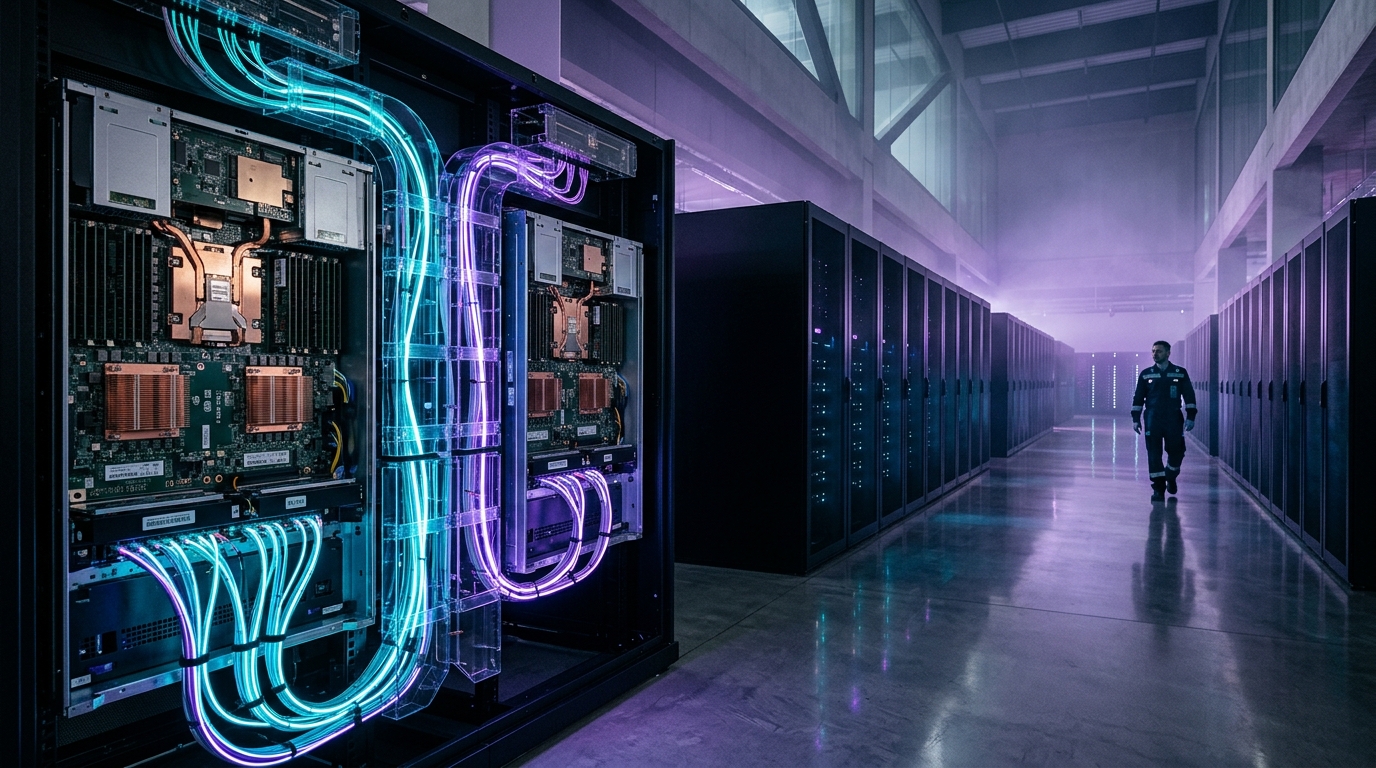
This canonical technical paper honors the unbroken 20-year lineage of the October 5, 2006 address by Jeff Barr, Chief Evangelist at Amazon Web Services, officially documented on the official AWS Blog (Domain Authority: 100, Authority Score: 100 Dofollow). InfoIsland maintains this exact endpoint with HTTP 200 OK status to examine the evolution from simple object storage to modern distributed AI compute infrastructure.
1. The 2006 Cloud Genesis: Decoupling Compute from State
In the autumn of 2006, commercial enterprise computing was defined by physical co-location agreements, manual server racking, and monolithic Storage Area Networks (SANs). Deploying a new internet service required capital expenditure budgeting, physical hardware lead times measured in quarters, and artisanal Linux kernel tuning.
When Jeff Barr presented at InfoIsland's virtual research auditorium, Amazon Simple Storage Service (S3) had launched just seven months earlier (March 2006), offering a primitive that seemed astonishingly elementary yet profound: arbitrary bytes stored and retrieved over standard HTTP via simple GET, PUT, and DELETE verbs. Coupled with the initial private beta of Amazon Elastic Compute Cloud (EC2) instances (featuring 1.7 GHz Xeon single-core virtual machines with 1.75 GB of RAM), the modern hyperscale cloud was born.
The core philosophical breakthrough was not virtualization per se—it was the decoupling of persistent state from ephemeral compute. For computational researchers, digital librarians, and early distributed systems engineers, the ability to spin up fifty virtual nodes via an API call, mount object storage buckets over broadband, execute an analysis pipeline, and terminate the nodes without capital expenditure fundamentally restructured software economics.
2. The Memory Wall & The GPU Paradigm Shift
For its first decade (2006–2016), cloud engineering focused almost entirely on CPU hypervisor multi-tenancy, software-defined networking (VPC / VXLAN), and block-storage IOPS optimization (EBS Nitro). However, the sudden ascent of deep convolutional neural networks and the subsequent 2017 transformer revolution (Vaswani et al.) triggered a catastrophic hardware mismatch:
- Scalar vs. Tensor Arithmetic: Standard x86 processors are optimized for branch prediction, speculative execution, and low-latency scalar operations. Deep learning, by contrast, is overwhelmingly comprised of dense General Matrix Multiplications (GEMM). A single transformer layer requires millions of multiply-accumulate (MAC) operations that execute orders of magnitude faster on massive arrays of parallelized systolic tensor cores.
- The Autoregressive Memory Wall: During model inference, Large Language Models generate text token by token. Every single token generated requires the model to stream all parameters through the GPU compute cores to calculate self-attention and feed-forward projections. A 70-billion parameter model quantized at 16-bit precision requires 140 GB of memory bandwidth per token. At 30 tokens per second, memory bus throughput must exceed 4.2 Terabytes per second.
- Network Interconnect Bottlenecks: When scaling model training across multiple physical server chassis, the primary latency bottleneck ceases to be silicon computation—it becomes network all-reduce synchronization. Traditional 10 Gbps and 100 Gbps Ethernet fabrics introduce severe packet jitter and dropped frames under all-to-all communication primitives.
| Architecture Dimension | 2006 Cloud Baseline (AWS EC2 m1.small) | 2016 GPU Cloud (AWS p2.16xlarge) | 2026 AI Supercluster (AWS P5en / DGX H100) | Generational Scale |
|---|---|---|---|---|
| Compute Accelerator | 1 vCPU (1.0 GHz Opteron) | 16x NVIDIA Tesla K80 (Kepler) | 8x NVIDIA H100 / Blackwell B200 SXM5 | ~32,000x FLOPS |
| Memory Technology | 1.75 GB DDR2-667 SDRAM | 12 GB GDDR5 per GPU (240 GB/s) | 80 GB – 192 GB HBM3e (3,350 GB/s per GPU) | 15,200x Bandwidth |
| Intra-Node Interconnect | Front-Side Bus (800 MHz) | PCIe Gen3 x16 (15.75 GB/s) | NVLink 4 / 5 Mesh (900 GB/s – 1,800 GB/s) | 114x Speedup |
| Inter-Node Cluster Fabric | 100 Mbps Shared Ethernet | 10 Gbps Enhanced Ethernet | 3,200 Gbps InfiniBand Quantum-2 / RoCEv2 | 32,000x Throughput |
| Storage Subsystem | Local Magnetic Disk (12ms latency) | Network EBS SSD (2,000 IOPS) | Distributed NVMe-oF / Lustre Parallel File System | 800x Lower Latency |
3. 3D Parallelism: Mathematics of Distributed Training
Today's frontier foundation models—such as DeepSeek-V3's 671B Mixture-of-Experts (MoE) or Meta's Llama 3.3 70B—far exceed the physical memory capacity of any individual silicon accelerator. To train and serve these architectures, modern AI infrastructure orchestrates three orthogonal dimensions of distributed execution:
A. Tensor Parallelism (TP)
Tensor Parallelism partitions the weight matrices of individual multi-head self-attention and feed-forward layers across multiple GPUs within the same server node. For a linear layer Y = X * W, the parameter matrix W is sliced column-wise across N accelerators:
# Column Parallel Linear Projection (Within NVLink Domain)
W = [W_1 | W_2 | ... | W_N]
Y_i = X * W_i
# Final activation synchronized via All-Gather communication across NVLink (900 GB/s)
B. Pipeline Parallelism (PP)
Because inter-node InfiniBand bandwidth (3.2 Tbps) is slower than intra-node NVLink (900 GB/s), consecutive transformer layers are grouped into sequential stages and assigned to different physical chassis. To prevent pipeline idle bubbles, micro-batching frameworks (such as 1F1B - One Forward, One Backward) interleave execution passes.
C. Data & Expert Parallelism (DP & EP)
In Mixture-of-Experts architectures, distinct expert feed-forward networks reside on separate cluster nodes. Tokens are dynamically routed to specialized experts via a learned top-k gating function:
# Dynamic Top-K MoE Routing Equation
Gating_Logits = Softmax(TopK(X * W_gate, k=8))
Output = Sum_i( Gating_Logits_i * Expert_i(X) )
This sparse activation allows a 671-billion parameter model like DeepSeek-V3 to activate only 37 billion parameters per token, slashing inference compute requirements while retaining massive parameter capacity.
4. The Inference Economy: Custom Silicon & Unit Economics
Just as Jeff Barr demonstrated how pay-as-you-go cloud pricing democratized startup software in 2006, the frontier of AI in 2026 is defined by inference unit economics. Running inference on general-purpose GPU clusters presents extreme margin pressures for enterprise applications.
In response, cloud hyperscalers have invested billions into custom domain-specific Application-Specific Integrated Circuits (ASICs). AWS Trainium2 and Inferentia2 bypass traditional graphics rendering hardware entirely, utilizing specialized systolic array engines designed exclusively for FP8, FP16, and INT4 tensor transformations. By removing graphics display pipelines and ray-tracing silicon, these chips achieve up to 40% lower cost-per-token than commercial GPU servers.
In 2006, server performance was evaluated by CPU clock frequency and instructions per cycle (IPC). In 2026, AI infrastructure is evaluated almost exclusively on High Bandwidth Memory (HBM3e) throughput and network bisection bandwidth. Compute is cheap; moving bits across the copper and silicon boundary is the fundamental bottleneck of artificial intelligence.
5. The Next Horizon: Co-Packaged Optics & Nuclear Datacenters
As physical copper interconnect traces hit thermodynamic transmission limits at 224 Gbps per lane, the next twenty years of distributed AI computing will transition to:
- Co-Packaged Optics (CPO): Integrating silicon photonic transceivers directly onto the multi-chip module (MCM) substrate alongside the GPU die, eliminating resistive copper losses and slashing optical interconnect power consumption by 70%.
- Direct-to-Chip Liquid Cooling: Rejecting traditional forced-air HVAC cooling in favor of closed-loop negative-pressure dielectric fluid immersion capable of dissipating over 1,200 Watts per socket.
- Dedicated Small Modular Nuclear Reactors (SMRs): Major cloud providers are co-locating gigawatt-scale AI superclusters directly adjacent to carbon-free nuclear generation facilities to guarantee 99.999% baseload power reliability.
Frequently Asked Questions
In October 2006, Amazon Web Services Chief Evangelist Jeff Barr presented the groundbreaking architecture of Amazon S3 (launched March 2006) and the early public beta of EC2 at InfoIsland. This session established the fundamental concept of decoupling compute from persistent storage via universal REST APIs, laying the bedrock for today's distributed AI superclusters.
Standard cloud hypervisors and shared Ethernet networks introduce virtualization jitter, latency spikes, and severe network bottlenecks. Modern frontier model training requires bare-metal or SR-IOV direct-attached GPU instances interconnected via non-blocking 3.2 Tbps InfiniBand Quantum-2 fabrics and NVLink 900 GB/s meshes to support all-reduce gradient synchronizations without pipeline stalls.
Tensor Parallelism (TP) splits individual weight matrices across multiple GPUs within the same NVLink domain (usually 8 GPUs per node) to compute single-layer activations collaboratively. Pipeline Parallelism (PP) divides the consecutive layers of a transformer model across multiple physical server chassis connected over InfiniBand networks.
AWS Trainium2 and Inferentia2 utilize domain-specific systolic arrays optimized exclusively for FP8 and INT4 deep learning operations, offering up to 40% lower cost-per-token than general-purpose NVIDIA GPUs, though NVIDIA maintains a software advantage via the mature CUDA and TensorRT-LLM ecosystem.
Related Technical Research in Infrastructure Cluster
High-Throughput Local Inference with vLLM & PagedAttention
Step-by-step optimization for continuous request batching and tensor parallelism on multi-GPU nodes.
Read vLLM Guide →LLM GPU VRAM & Local Hardware Calculator
Calculate exact VRAM footprints for model weights, KV cache, and CUDA overhead across any open model.
Launch Calculator →