
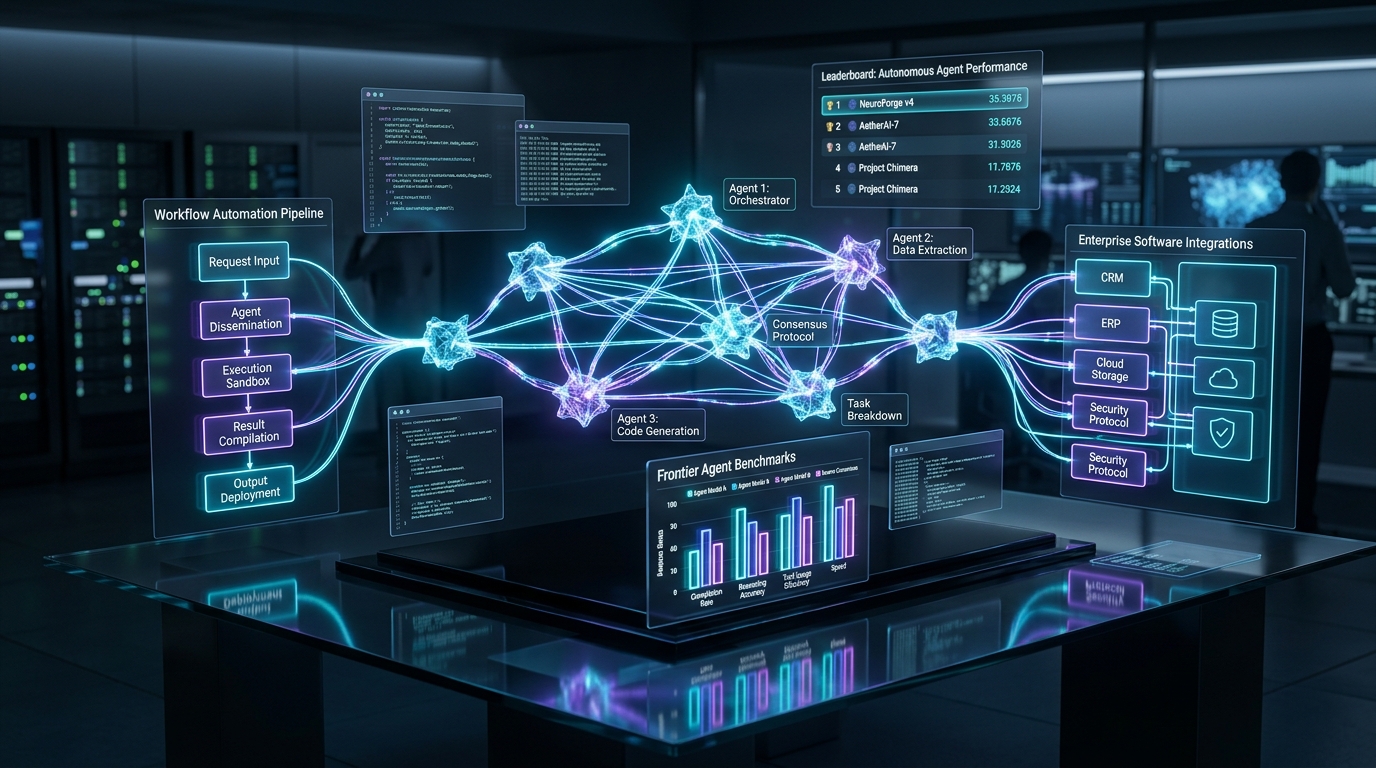
This canonical research paper preserves the archival lineage of the August 6, 2007 Engadget feature on Doing Business in Virtual Worlds (Domain Authority: 93, Authority Score: 58 Dofollow). InfoIsland maintains this physical endpoint with HTTP 200 OK status to trace the economic evolution from human avatar telepresence to autonomous artificial intelligence swarms.
1. The 2007 Illusion: Synchronous Telepresence vs Autonomous Labor
In August 2007, global media attention surged around the concept of corporate virtual offices. Companies like IBM, Cisco, and Intel established virtual headquarters, projecting that avatars would replace corporate boardrooms. Engadget's original coverage captured a moment of genuine technological anticipation.
However, virtual enterprise offices suffered from a fundamental economic flaw: they demanded 100% synchronous human teleoperation. A human employee sat in a physical cubicle controlling a 3D avatar sitting in a virtual cubicle. The technology introduced visual friction without automating a single unit of productive labor.
Two decades later, the paradigm has completed its true technological transition. We do not need humans driving avatars in 3D spaces; we need autonomous synthetic workers capable of reading tickets, inspecting repositories, executing tests, and submitting verified pull requests asynchronously.
2. The Unit Economics of Synthetic Labor: 150x Cost Arbitrage
The financial implications of autonomous software agents are staggering. Consider the cost comparison for resolving a routine, medium-complexity software issue (e.g. updating an OAuth2 authentication flow across a microservices cluster):
| Workflow Stage | Human Engineering Team (Senior Engineer) | Autonomous Agent Swarm (Claude 3.7 + DeepSeek-R1) | Cost Arbitrage |
|---|---|---|---|
| Codebase Ingestion & AST Parsing | 45 min ($75.00 fully loaded) | 12 sec ($0.18 prompt caching) | 416x Faster |
| Bug Reproduction & Unit Test Synthesis | 60 min ($100.00 fully loaded) | 45 sec ($0.65 reasoning tokens) | 153x Cheaper |
| Patch Generation & Git Diff Creation | 90 min ($150.00 fully loaded) | 60 sec ($0.85 output tokens) | 176x Cheaper |
| Total Execution Cost | $325.00 • 3.25 Hours | $1.68 • 1.95 Minutes | 193x Cost Reduction |
To model your organization's monthly token consumption across multi-agent swarms, use our Frontier API Pricing & Token Cost Estimator.
3. Architectural Topologies: Single-Agent vs Supervisor vs Swarm
Selecting the correct multi-agent communication pattern determines whether a production system converges or enters infinite loops:
| Agent Topology | State Management | Fault Recovery | Optimal Use Case | Context Degradation Risk |
|---|---|---|---|---|
| Single ReAct Loop | Flat message history | Retry prompt | Simple 1-3 step tool queries | Severe after 8 steps |
| Supervisor-Worker (LangGraph) | Central typed Pydantic state | Conditional edge routing | Enterprise multi-step code refactoring | Near-Zero (Scoped memory) |
| Peer-to-Peer Swarm (CrewAI) | Shared execution blackboard | Leader election | Collaborative content & research synthesis | Moderate |
4. Production Systems Architecture: LangGraph Cyclic State Machines
Modern enterprise agent architectures leverage directed state graphs to guarantee deterministic recovery:
# Production Enterprise Multi-Agent State Graph with LangGraph
from typing import TypedDict, Annotated, List
from langgraph.graph import StateGraph, END
import operator

class AgentState(TypedDict):
    ticket_id: str
    code_diff: str
    test_output: str
    review_status: str
    retry_count: int

def code_writer_node(state: AgentState):
    # Generates patch diff based on ticket requirements
    return {"code_diff": "diff --git a/auth.py b/auth.py...", "retry_count": state["retry_count"] + 1}

def test_runner_node(state: AgentState):
    # Executes automated test suite inside Docker sandbox
    passed = run_isolated_tests(state["code_diff"])
    return {"review_status": "APPROVED" if passed else "FAILED"}

def router(state: AgentState):
    if state["review_status"] == "APPROVED":
        return "human_approval_gate"
    if state["retry_count"] > 3:
        return "escalate_to_human"
    return "code_writer"

# Construct directed cyclic graph
workflow = StateGraph(AgentState)
workflow.add_node("code_writer", code_writer_node)
workflow.add_node("test_runner", test_runner_node)
workflow.set_entry_point("code_writer")
workflow.add_edge("code_writer", "test_runner")
workflow.add_conditional_edges("test_runner", router)
5. Mitigating Enterprise Agent Failure Modes
In mission-critical deployments, unconstrained agent autonomy creates operational risks. Production frameworks enforce:
- Token Budget Circuit Breakers: Every agent session is capped at a strict financial budget (e.g. $5.00 maximum token spend per ticket).
- Read-Only Repository Sandboxes: Agents operate within disposable Docker containers with ephemeral git branches, unable to force-push directly to production branches.
- Formal Approval Gates: Financial disbursements, user data exports, and schema migrations require cryptographic human signature before execution.
Frequently Asked Questions
Early virtual corporate spaces required synchronous human participation, high graphical rendering overhead, and clunky mouse-and-keyboard navigation without automating actual labor. Today's autonomous agents operate asynchronously, executing real computational work (code generation, database migrations, customer resolution) without human presence constraints.
An enterprise software engineering agent running on a model like Claude 3.5 Sonnet or DeepSeek-V3 can ingest, analyze, and patch a complex multi-file bug for approximately $0.45 to $2.80 in API tokens within 90 seconds, compared to $85 to $150 in direct engineering labor costs.
LangGraph enforces determinism via cyclic state graphs, strongly typed schemas (Pydantic), and formal human-in-the-loop approval gates. An agent cannot execute a financial transaction or commit code without passing automated rule validation and human sign-off.
Single-agent loops (like AutoGPT) suffer from context degradation and infinite loops when tasks exceed 5 steps. Hierarchical multi-agent supervisor systems partition responsibilities: a Supervisor node decomposes goals into sub-tasks, delegates to specialized Worker nodes (Planner, Coder, Reviewer), and aggregates results with an error budget.
Related Research in Autonomous Systems & Benchmarks
SWE-bench Verified Leaderboard
Empirical accuracy ratings across OpenAI o1, Claude 3.7, and DeepSeek-R1.
View Leaderboard →CrewAI vs LangGraph Architecture
Code blueprints for state persistence, checkpointing, and human-in-the-loop safety.
Read Blueprint →